Understanding the KJSEA Results
Alex Otieno
The Wait is Over: The Pioneer Cohort Results Are Here
If you are reading this, you likely have the result slip for the Kenya Junior Secondary Education Assessment (KJSEA) in your hands—or you’re frantically refreshing the KNEC portal. Yesterday, December 11, 2025, marked a historic moment in Kenya’s education landscape. The pioneer class of the Competency-Based Curriculum (CBC) received their Grade 9 assessment results, signaling the end of Junior Secondary School (JSS) and the beginning of the transition to Senior School.
But as you look at the results, you might notice something different. Gone are the days of a simple "350 marks" or a "B-". In their place is a matrix of levels, codes like "EE1" or "ME2," and a cumulative point system capped at 72.
If you feel confused, you are not alone. This system represents a paradigm shift from the 8-4-4 ranking mentality to a competence-based evaluation. This guide will break down exactly how the grading works, how the points are calculated, and what this means for your child’s placement in Grade 10 next month.
The Big Shift: Competence Over Competition
The most significant change with KJSEA is the philosophy. The traditional KCPE exam was a "summative" elimination tool—one exam determined your entire high school destiny. The KJSEA, however, is designed to assess mastery. It asks: Does the learner possess the skills required for the next level?
The results you see are not just about raw marks; they are about Achievement Levels. These levels categorize how well a learner has mastered the curriculum's specific learning areas.
The Grading Grid: Decoding the Acronyms
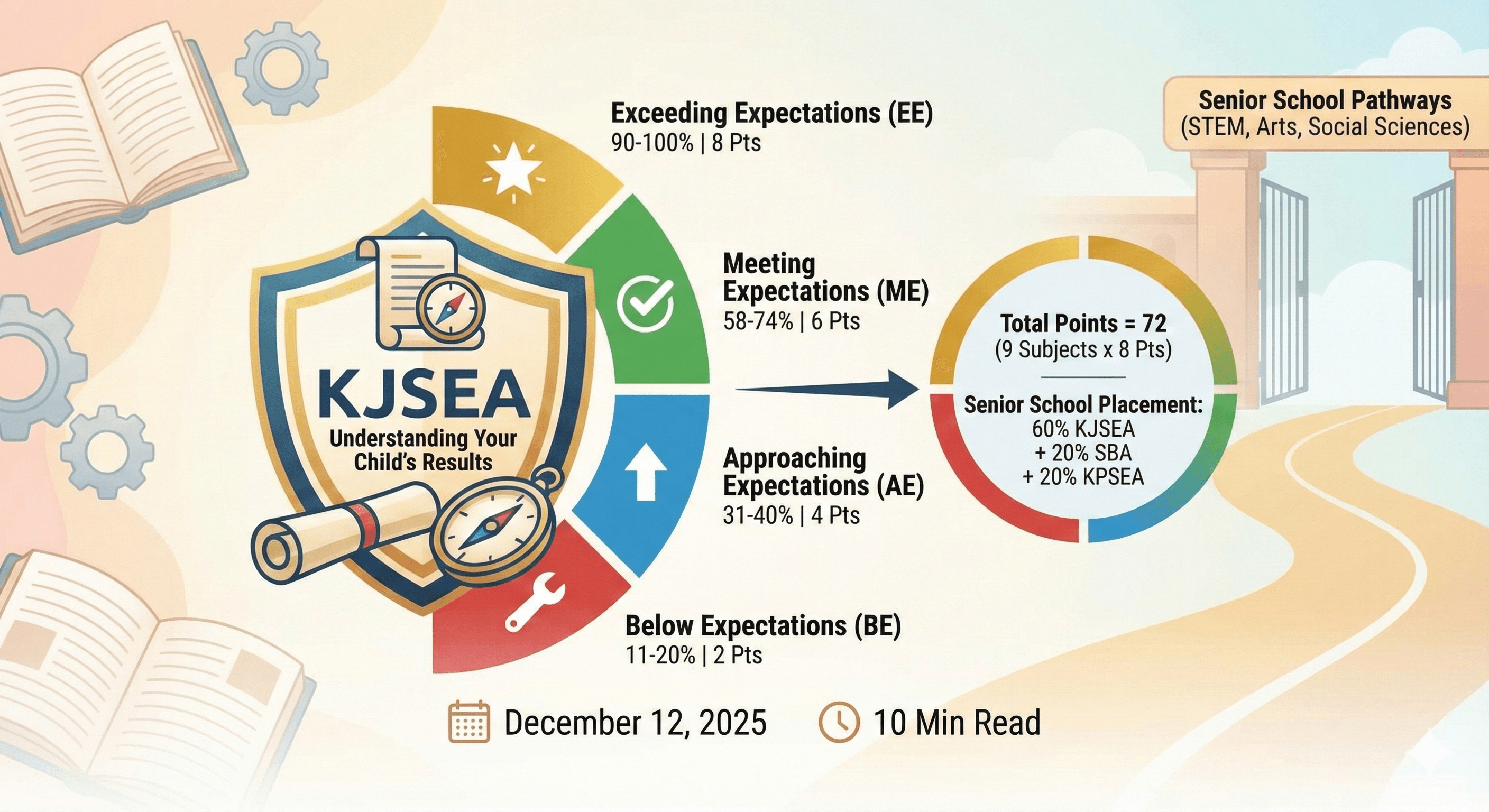
Your child’s performance in each of the 9 Learning Areas (subjects) is rated on a four-tier scale. However, to add precision, each tier is split into two sublevels, creating an 8-point scale.
Here is the breakdown of the grading structure as released by KNEC:
1. Exceeding Expectations (EE) – The "Gold Standard"
This is the highest level of mastery. A learner here hasn't just memorized the work; they can apply it creatively and consistently.
EE1 (90% - 100%): Awarded 8 Points. This is the pinnacle of performance.
EE2 (75% - 89%): Awarded 7 Points. Highly competent and ready for advanced pathways.
2. Meeting Expectations (ME) – The "Safe Zone"
This indicates the learner has acquired the necessary skills to move forward without major hurdles.
ME1 (58% - 74%): Awarded 6 Points. A solid, strong performance.
ME2 (41% - 57%): Awarded 5 Points. The learner meets the basic requirements but may need to polish some areas.
3. Approaching Expectations (AE) – The "Work in Progress"
Learners in this band have grasped some concepts but show inconsistency. They will need support in Senior School.
AE1 (31% - 40%): Awarded 4 Points.
AE2 (21% - 30%): Awarded 3 Points.
4. Below Expectations (BE) – The "Intervention Needed"
This level signals that the learner has significant gaps in understanding the core competencies.
BE1 (11% - 20%): Awarded 2 Points.
BE2 (1% - 10%): Awarded 1 Point.
The Math: Understanding the "Magic Number" 72
You might be asking, "Why is the total score out of 72?"
Unlike the 500 marks of KCPE, the KJSEA aggregate is derived from the points associated with the achievement levels, not the raw percentages.
There are 9 Learning Areas (Subjects).
The maximum score per subject is 8 Points (for an EE1 grade).
Therefore: 9 Subjects × 8 Points = 72 Maximum Points.
The Average Benchmark: A score of 36 Points is considered the average achievement (equivalent to scoring an average of 4 points, or AE1, across all subjects). A score significantly above 36 indicates a learner is generally meeting or exceeding the curriculum demands.
Beyond the Exam: The 60-20-20 Rule
It is crucial to remember that the results released yesterday are just one piece of the puzzle. The Ministry of Education and KNEC are using a weighted formula for Senior School placement:
KJSEA (Grade 9 Exam): Contributes 60% to the final placement score.
School-Based Assessments (SBA): Assessments done in Grades 7 and 8 contribute 20%.
KPSEA (Grade 6 Exam): The primary school assessment contributes the final 20%.
This holistic approach ensures that a student's destiny isn't sealed by a "bad day" in the exam room. It rewards consistency over three years of Junior School.
What This Means for Grade 10 Placement
The anxiety surrounding these results is naturally linked to Senior School (Grade 10) placement. Under CBC, students do not just go to "high school"; they choose a Career Pathway.
Based on the points gathered (out of 72) and the subject strengths (e.g., high scores in Integrated Science vs. Creative Arts), learners will be placed into one of three major tracks:
Science, Technology, Engineering, and Mathematics (STEM): Requires high performance in Mathematics and Integrated Science (likely EE or high ME levels).
Social Sciences (Humanities): For learners strong in Languages, History, and Religious Education.
Arts and Sports Science: For learners exhibiting talent (EE levels) in Creative Arts, Performing Arts, or Physical Education.
The "National School" Concept: While the categorization of schools (National, Extra-County, etc.) still exists in terms of facilities, the focus is now on which school offers the pathway your child is qualified for. A student with 65/72 points will likely secure their first-choice pathway in a top-tier Senior School.
Conclusion: A Journey, Not a Destination
As you review the results, try to shift the conversation with your child. Instead of asking, "Why didn't you get an A?", look at the breakdown. Did they get an EE1 in Arts but an AE2 in Math? This isn't a failure; it's a roadmap. It tells you clearly that your child is artistically gifted and may flourish in an Arts pathway rather than being forced into a pure Science track.
The release of these results is a celebration of the first full cycle of Junior Secondary education in Kenya. Whether your child scored a 25 or a 68, the system is built to ensure they have a place in Grade 10 where their specific competencies can be nurtured.